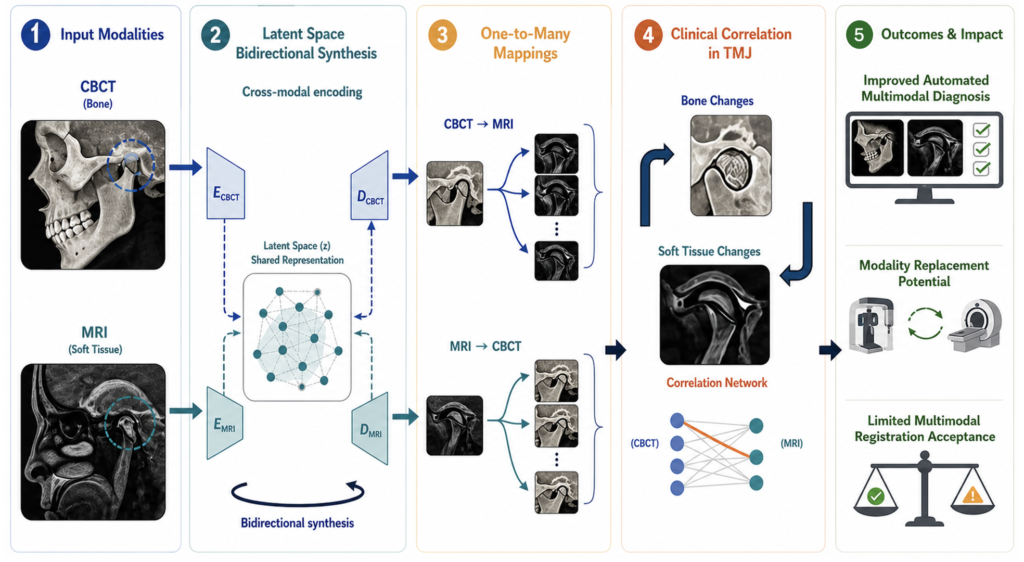
Contemporary advances in artificial intelligence have made it increasingly tempting to frame modality transformation as a solvable imaging problem. Yet within temporomandibular joint (TMJ) diagnostics, the relationship between CBCT and MRI cannot be reduced to a simple matter of visual translation. These modalities do not merely differ in appearance; they encode distinct anatomical emphases, different diagnostic affordances, and fundamentally non-equivalent forms of clinical evidence. This research aims to investigate the fundamental limits of information transfer between CBCT and MRI of the TMJ.
Rather than approaching cross-modality synthesis as an exercise in image generation alone, this research is positioned under what conditions such probabilistic estimation remains clinically meaningful, biologically defensible, and interpretively responsible. This distinction is not semantic; it has significant implications for how synthetic outputs should be interpreted, validated, and ultimately situated within clinical decision-making. In domains where absent information is not directly encoded in the source modality, the question shifts from technical plausibility to epistemic legitimacy. Hence, it reflects a commitment to a more critical and methodologically mature understanding of medical AI.
TMJ offers a particularly demanding and illuminating testbed. It is a region in which osseous morphology, soft tissue status, functional loading, spatial positioning, and clinical symptomatology intersect in ways that resist simplistic mapping. As such, any effort to infer complementary imaging information across modalities must contend not only with algorithmic uncertainty, but also with the deeper issue of whether the inferred representation reflects underlying anatomy, population-level statistical regularities, or a model-imposed narrative of coherence. In that sense, the project is designed as both a technical investigation and a conceptual intervention into how synthetic medical imaging should be understood in domains marked by incomplete observability, modality asymmetry, and diagnostic uncertainty.
Several interrelated dimensions are concerned, including the clinical significance of inferred multimodal information; the extent to which latent cross-modal associations can support meaningful interpretation; the limits of substitutability between acquired and inferred imaging evidence; and the role of uncertainty-aware AI, the translational value of cross-modal inference for image integration, computational workflow augmentation, and future clinically grounded decision-support systems. Accordingly, it is expected to answer the following questions:
We welcome interdisciplinary collaboration from researchers and clinicians working across artificial intelligence, TMJ imaging, dentomaxillofacial radiology, multimodal registration, computational anatomy, and clinically interpretable model evaluation. We also invite patients and radiology centers to participate through radiograph donation under the privacy regulations.