Decisions to save or extract severely compromised teeth remain among the most contested judgments in dentistry—not because clinicians lack evidence, but because clinical meaning is distributed across specialties with different success definitions, time horizons, and value commitments. In borderline cases (e.g., combined endodontic–periodontal compromise with uncertain restorative prognosis), “the correct answer” is rarely a single prediction; it is the outcome of disciplined deliberation, trade-off articulation, and risk negotiation.
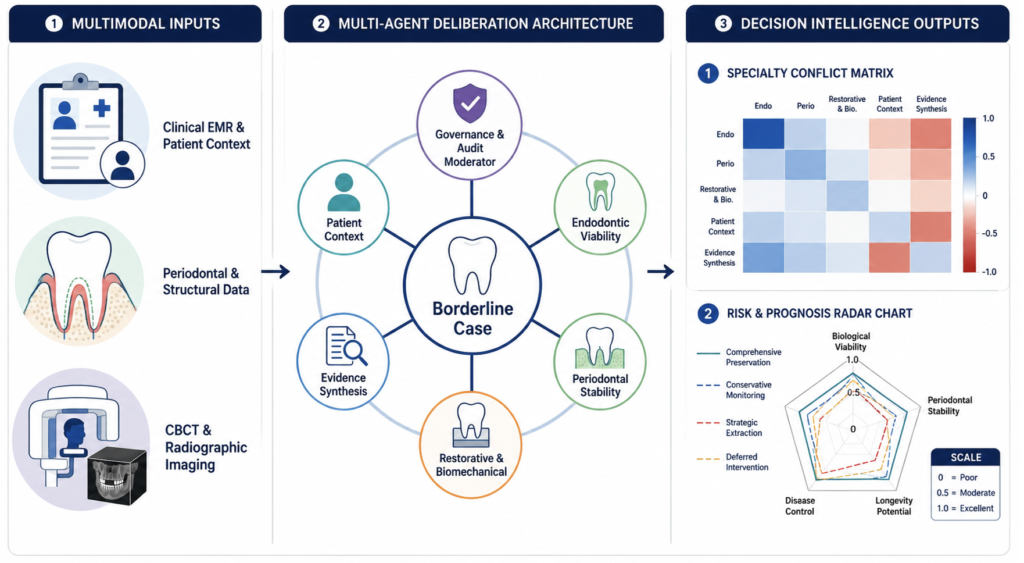
This project introduces a governance-oriented multi-agent clinical AI framework that treats interdisciplinary disagreement as signal rather than noise. Instead of forcing consensus or producing a binary directive, the system constructs a calibrated Option Space: a probabilistic mapping of plausible treatment pathways together with an explicit account of where and why specialty perspectives diverge. The output is designed to function as a structured deliberation artifact – highlighting competing therapeutic hypotheses, surfacing missing decisive information, and rendering trade-offs legible between biological viability, biomechanical longevity, and patient-specific constraints.
By shifting clinical AI from an “answer machine” to an uncertainty-structuring collaborator, the project contributes a practical model for clinical AI governance: transforming complex, multimodal clinical uncertainty into transparent, contestable, and patient-centered risk reasoning that supports shared decision-making without erasing legitimate disciplinary plurality.
We welcome collaborations with: