
Ocular infections remain one of the leading causes of postoperative complications and preventable vision impairment worldwide. Despite the widespread use of topical antibiotics, conventional ophthalmic formulations often exhibit limited therapeutic efficacy due to the unique physiological barriers of the eye. Rapid tear turnover, blinking, nasolacrimal drainage, and the limited residence time of eye drops significantly reduce drug bioavailability, resulting in the need for frequent administration to maintain effective antimicrobial concentrations. This treatment regimen may decrease patient compliance, increase ocular irritation, and compromise the overall success of therapy.
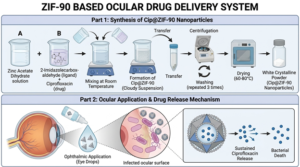
To overcome these limitations, this active research project investigates ZIF-90 as an advanced metal-organic framework (MOF) for sustained ocular drug delivery. The study focuses on the synthesis, characterization, and pharmaceutical evaluation of ZIF-90 as a nanocarrier for the controlled release of ciprofloxacin in ocular infections
Metal-organic frameworks have recently emerged as one of the most promising classes of porous nanomaterials for biomedical applications because of their exceptionally high surface area, tunable pore architecture, structural versatility, and high drug-loading capacity. Among them, ZIF-90 has attracted considerable attention owing to its excellent chemical stability, favorable biocompatibility, and reactive aldehyde functional groups that enable efficient interaction with therapeutic molecules. These characteristics make ZIF-90 an attractive candidate for the development of next-generation ophthalmic drug delivery systems capable of improving drug retention and reducing dosing frequency.
The primary objective of this project is to synthesize highly crystalline ZIF-90 nanoparticles and evaluate their suitability as carriers for ciprofloxacin encapsulation. Particular emphasis is placed on optimizing the synthesis of ZIF-90, improving its structural stability, and achieving high drug-loading efficiency while preserving the physicochemical properties of both the framework and the antibiotic. The project also investigates how the structural characteristics of ZIF-90 influence drug encapsulation, release kinetics, and overall performance as an ocular drug delivery platform.
Comprehensive physicochemical characterization of ZIF-90 will be performed using complementary analytical techniques to evaluate crystallinity, particle morphology, surface chemistry, functional groups, particle size distribution, thermal stability, and framework integrity. These analyses will verify the successful synthesis of ZIF-90 and determine its suitability as a nanocarrier for ocular drug delivery.
A major focus of this research is the investigation of controlled and sustained drug release under physiologically relevant conditions. Unlike conventional eye drops that release the entire drug dose immediately after administration, the proposed ZIF-90 nanocarrier is designed to gradually release ciprofloxacin over an extended period. Maintaining therapeutic drug concentrations for longer durations has the potential to improve antibacterial efficacy while reducing the frequency of administration, minimizing fluctuations in drug concentration, and enhancing patient adherence to treatment.
Beyond material synthesis and drug loading, this project also seeks to establish relationships between nanoparticle properties and drug release behavior. Understanding how factors such as pore structure, particle morphology, crystallinity, and framework stability influence release kinetics will contribute to the rational design of optimized MOF-based ophthalmic drug delivery systems. Such knowledge may facilitate the development of customizable nanocarriers for a wide range of therapeutic agents beyond antibiotics.
The broader vision of this research extends beyond the treatment of postoperative ocular infections. The proposed platform may provide a versatile foundation for future ophthalmic drug delivery technologies, including sustained delivery of anti-inflammatory agents, antifungal drugs, antiviral therapeutics, and other bioactive molecules requiring prolonged ocular residence. Furthermore, the modular chemistry of metal-organic frameworks offers opportunities for surface functionalization and targeted delivery, expanding their potential applications in precision ophthalmology and nanomedicine.
The proposed ZIF-90 platform may provide a versatile foundation for future ophthalmic drug delivery technologies. Beyond ciprofloxacin, ZIF-90 could potentially be adapted for the sustained delivery of anti-inflammatory, antifungal, antiviral, and other therapeutic agents, making it an attractive biomaterial for next-generation nanomedicine and precision ophthalmology.