
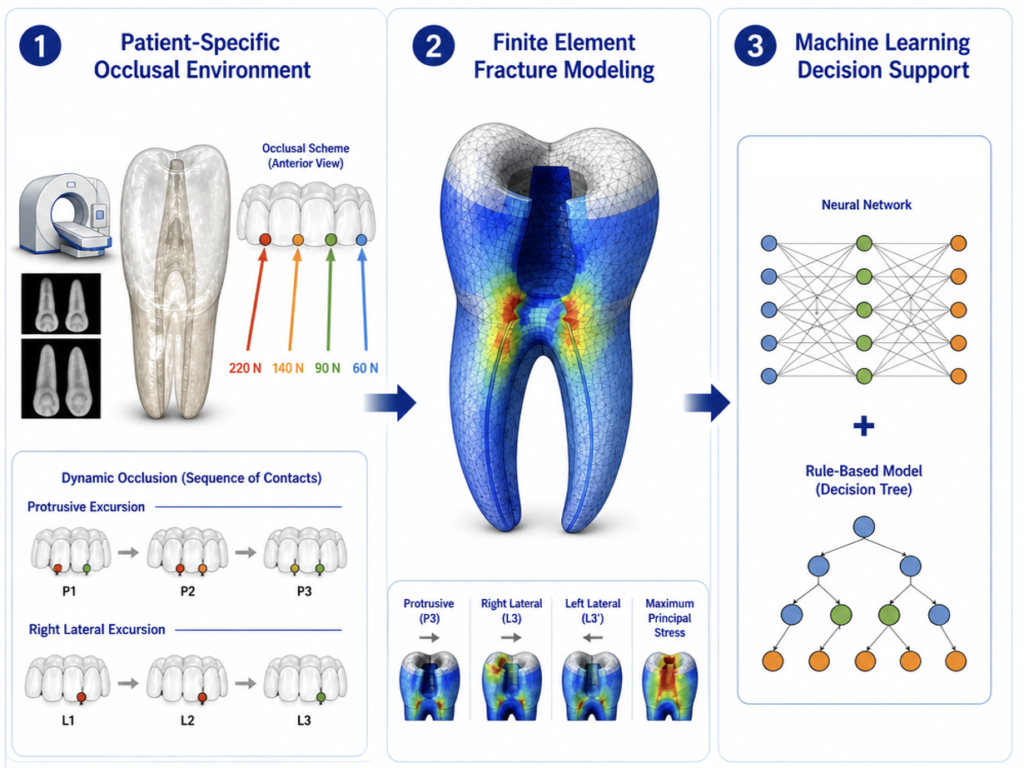
Endodontic access design is still commonly evaluated through geometric proxies—tissue loss, cavity size, and residual thickness—even though structural safety is ultimately negotiated under function. This project advances a shift from quantity-based conservation toward functionally strategic preservation, proposing that the biomechanical value of coronal structures is not intrinsic or uniform, but context-dependent, emerging from patient-specific occlusal demand and patterns of use.
Rather than treating access preparation as a standardized morphology problem, the research reframes it as a risk-governed planning task: fracture susceptibility is understood as an emergent consequence of the interaction between anatomy, intervention, restoration, and functional loading. The program integrates computational biomechanical reasoning with data-driven inference to construct an interpretable decision structure capable of supporting clinically defensible access planning under uncertainty-shifting the key clinical question from how much can be preserved to what should be preserved, for whom, and under which functional circumstances.
Using micro-CT–derived tooth models, finite element analysis will be performed to simulate fracture risk under a range of loading scenarios. A fracture-risk objective function will be used to map stress concentration and structural vulnerability across the tooth and access-design variants. The resulting dataset will then be used to train a machine-learning model capable of supporting clinical decision-making by linking occlusal phenotype, cavity configuration, and biomechanical risk.
The project seeks to characterize how different occlusal conditions reshape the mechanical value of individual coronal regions and consequently alter the structural implications of access preparation. Accordingly, it focuses on three main objectives;