
Nanogels have emerged as one of the most promising nanocarriers for advanced drug delivery because of their high water content, excellent biocompatibility, large drug-loading capacity, and highly tunable physicochemical properties. Their three-dimensional polymeric network enables efficient encapsulation of a broad range of therapeutic agents, including small-molecule drugs, proteins, peptides, nucleic acids, and biological therapeutics. Owing to these unique characteristics, nanogels are increasingly being investigated for applications in controlled drug delivery, targeted therapy, regenerative medicine, cancer treatment, tissue engineering, and precision medicine.
Despite their significant potential, producing nanogels with consistent particle size, narrow size distribution, and reproducible physicochemical properties remains a major challenge. Conventional batch synthesis methods often suffer from poor mixing efficiency, uncontrolled reaction environments, and batch-to-batch variability, leading to heterogeneous nanocarrier populations. Since the size and uniformity of nanogels directly influence drug loading, release kinetics, biodistribution, cellular uptake, and therapeutic efficacy, precise control over the synthesis process is essential for developing reliable pharmaceutical formulations.
This active research project focuses on the development of an advanced microfluidic platform for the controlled synthesis of nanogels through computational modeling and numerical simulation. Compared with traditional bulk mixing methods, microfluidic systems offer precise control over fluid manipulation at the microscale, enabling rapid and highly reproducible mixing while significantly reducing reagent consumption. These advantages make microfluidic technology an attractive approach for producing high-quality nanocarriers with improved reproducibility and scalability.
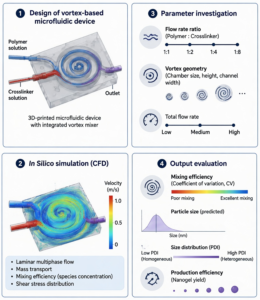
The primary objective of this project is to develop an in-silico Computational Fluid Dynamics (CFD) model of a vortex-based microfluidic device specifically designed for nanogel synthesis. The computational model will simulate fluid flow, vortex formation, mixing behavior, and mass transport inside the microchannels to better understand the mechanisms governing nanogel formation. By evaluating these microscale hydrodynamic phenomena, the project seeks to establish engineering guidelines for optimizing the hydrogel nanoparticles production before experimental fabrication is undertaken.
Particular emphasis will be placed on investigating the influence of vortex geometry, channel architecture, flow rate, flow rate ratio, and mixing intensity on the formation of nanogels. These operating parameters directly affect the interaction between precursor solutions, influencing nucleation, polymer crosslinking, particle growth, and ultimately the final size distribution and uniformity of the synthesized the hydrogel nanoparticles. Understanding these relationships is essential for designing reproducible manufacturing processes capable of producing pharmaceutical-grade nanomaterials.
The numerical simulations will provide detailed information regarding velocity fields, pressure distribution, streamline patterns, vortex generation, residence time, and mixing efficiency throughout the microfluidic device. These computational analyses will improve our understanding of how local flow conditions affect nanogel synthesis and how different device geometries can be optimized to achieve more homogeneous particle formation. The simulation framework will also enable systematic comparison of multiple design configurations without the cost and time associated with repeated laboratory experiments.
Another important objective of this research is to identify operating conditions that maximize mixing efficiency while maintaining stable hydrodynamic performance inside the microfluidic platform. By optimizing these parameters computationally, the project aims to reduce experimental trial-and-error, accelerate device development, and facilitate the scalable production of uniform nanogels for biomedical applications. The resulting computational framework is expected to support more efficient experimental design by identifying promising operating conditions before laboratory validation, ultimately shortening the development cycle for new nanocarrier formulations.
In addition to optimizing operating parameters, this project seeks to establish a predictive computational framework linking microfluidic conditions with expected nanogel characteristics. Such a framework may serve as the foundation for future experimental validation and could eventually be integrated with machine learning and optimization algorithms to support data-driven development of next-generation microfluidic manufacturing systems. The combination of computational simulation and experimental verification has the potential to improve reproducibility while providing deeper insight into the mechanisms governing nanogel formation.
The broader significance of this research extends beyond nanogel synthesis alone. The computational methodologies developed in this project may also be applicable to the fabrication of polymeric nanoparticles, hydrogels, nanoemulsions, liposomes, and other advanced biomaterials that require rapid and homogeneous microscale mixing. Consequently, the knowledge generated through this work may contribute to a wide range of biomedical engineering, pharmaceutical sciences, and nanotechnology applications where precise control over particle synthesis is essential.
By integrating expertise in nanogels, microfluidics, computational fluid dynamics, drug delivery, and biomedical engineering, this active research project aims to establish a scientifically grounded framework for the rational design of advanced microfluidic platforms for nanogel synthesis. Rather than relying solely on conventional experimental optimization, the project leverages computational simulation to better understand fluid behavior, mixing mechanisms, and process parameters that govern nanogel formation. Ultimately, this research is expected to provide valuable design guidelines for future experimental studies and contribute to the development of scalable, reproducible, and efficient nanogel manufacturing technologies for advanced drug delivery applications.