
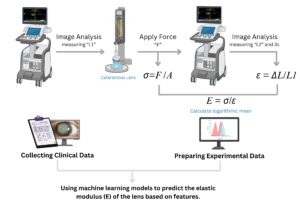
Human lens stiffness is a fundamental biomechanical property that directly influences the success of cataract surgery, particularly during phacoemulsification, where ultrasound energy must be carefully adjusted according to the hardness of the cataractous lens. Accurate estimation of lens stiffness before surgery can improve surgical planning, reduce unnecessary ultrasound exposure, minimize tissue damage, and ultimately enhance patient safety and visual outcomes. However, current clinical practice relies primarily on the surgeon’s subjective intraoperative assessment of lens hardness, which may vary depending on individual experience and does not provide a quantitative preoperative evaluation.
To address this limitation, this study proposes a non-invasive, machine learning–based framework for predicting the biomechanical stiffness of the human cataractous lens using routinely available demographic and clinical information. The proposed approach aims to provide clinicians with a practical decision-support tool that can estimate lens stiffness before surgery without requiring additional imaging systems or invasive biomechanical measurements.
A total of 50 human lens nuclei were collected from patients undergoing extracapsular cataract extraction (ECCE) surgery. Following extraction, each lens specimen was subjected to a standardized compressive load of 0.2 N, while deformation was monitored using ultrasound imaging. The measured deformation was subsequently used to calculate Young’s modulus, which served as the reference biomechanical indicator of lens stiffness for model development.
The predictive variables included several routinely collected preoperative clinical parameters, namely Age, Gender, Cataract Grade, Lens Diameter, Diabetes Status, and Aspirin Use. Because these variables are already available during routine ophthalmic examinations, the proposed method can be readily integrated into existing clinical workflows without increasing patient burden or healthcare costs.
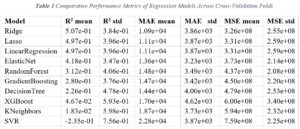
Data preprocessing, feature normalization, model training, hyperparameter optimization, and performance evaluation were carried out in Python using the Scikit-learn machine learning library. A total of ten supervised regression algorithms were implemented and systematically compared. Model performance was evaluated using Mean Squared Error (MSE) and the Coefficient of Determination (R²), allowing identification of the most accurate and generalizable predictive model while minimizing overfitting.
Best Predictive Model
Among the ten evaluated regression algorithms, Ridge Regression achieved the highest predictive performance. Compared with the other models, Ridge Regression demonstrated superior stability, lower prediction error, and better generalization capability, making it the most suitable algorithm for estimating cataract lens stiffness from relatively small clinical datasets.
Feature Importance Analysis
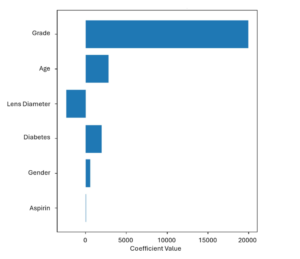
Feature importance was assessed using the coefficient importance of the Ridge Regression model.
The analysis revealed that Cataract Grade is the strongest predictor of biomechanical lens stiffness, confirming the well-established relationship between cataract progression and increasing lens rigidity. Age also contributed meaningfully to prediction accuracy, reflecting the natural age-related changes in lens composition and biomechanics. Lens Diameter exhibited a negative coefficient, suggesting an inverse relationship with the calculated Young’s modulus (Elog), although its contribution remained substantially lower than that of Cataract Grade.
In contrast, Gender and Aspirin Use showed only minor influence on model performance, indicating that these variables contribute little to predicting lens stiffness within the current dataset.
This study presents and validates a machine learning–based method for the preoperative prediction of human lens stiffness using readily available demographic and clinical information. The results demonstrate that important clinical variables—particularly Cataract Grade and Age—are significantly associated with the ex vivo biomechanical properties of the cataractous lens.
Among all evaluated machine learning algorithms, Ridge Regression provided the most robust and reliable predictive performance while effectively handling noise and multicollinearity within the dataset. Although the present model should be considered an exploratory and hypothesis-generating framework rather than a definitive clinical decision tool, it successfully captures meaningful biological trends, including the progressive increase in lens stiffness with advancing cataract severity.
The findings also suggest that combining artificial intelligence, machine learning, and clinical ophthalmic data can provide valuable insights into personalized surgical planning and preoperative biomechanical assessment. Such predictive models have the potential to support ophthalmic surgeons in selecting appropriate phacoemulsification parameters, reducing surgical complications, and improving patient-specific treatment strategies.
Because the present study was conducted using a relatively limited number of samples, the observed effects of systemic variables such as diabetes and aspirin use should be interpreted cautiously as preliminary observations. Larger multicenter prospective studies incorporating more diverse patient populations and additional imaging biomarkers are required to further validate and improve the predictive performance of the proposed framework.
Overall, this research establishes a foundational step toward AI-assisted cataract surgery planning, non-invasive lens biomechanics assessment, and future precision ophthalmology, demonstrating how machine learning can bridge experimental biomechanics and routine clinical practice.
DOI: 10.1186/s40001-026-04946-0